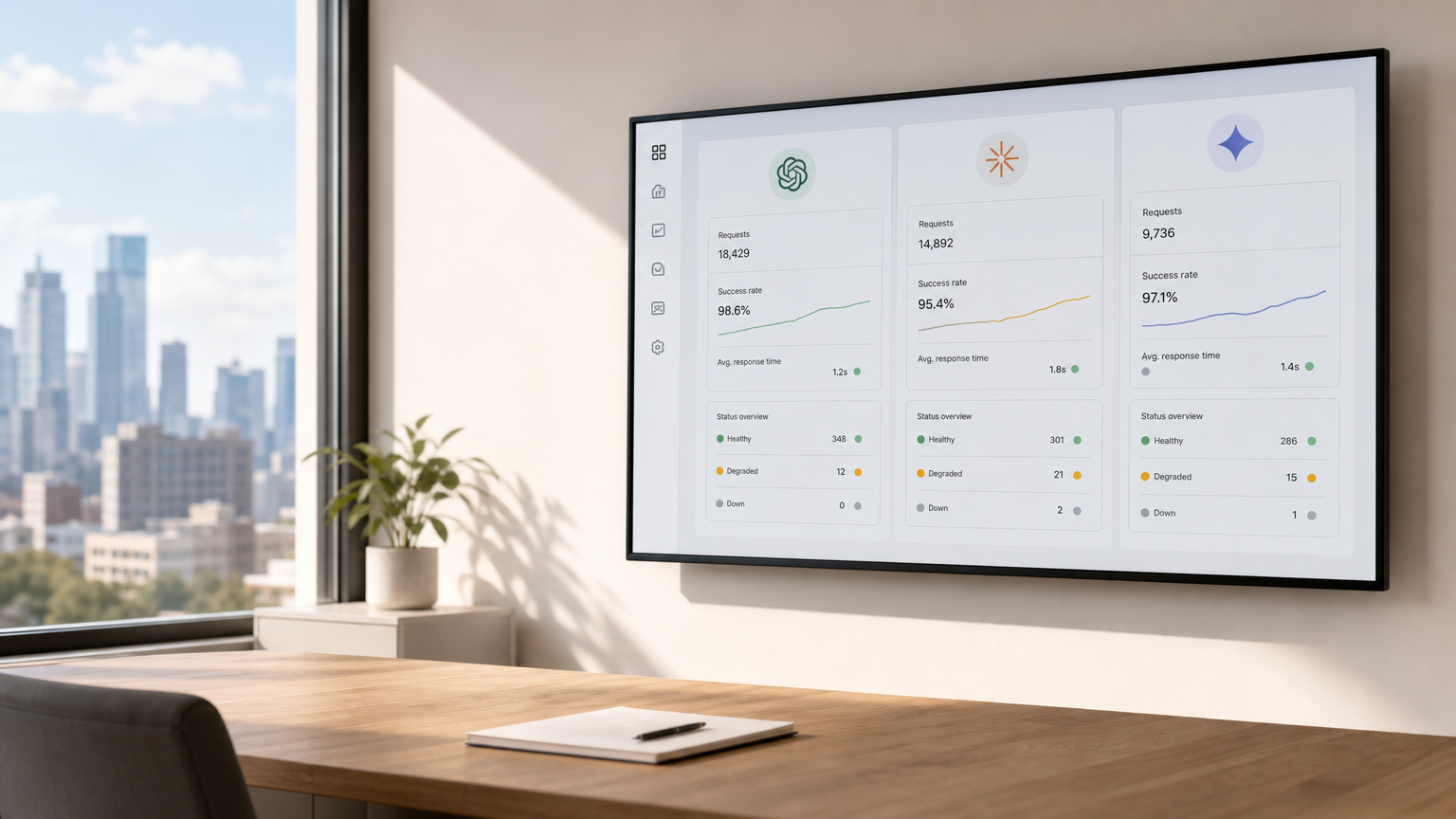
Your SEO team runs weekly ranking checks. Your comms team tracks press mentions daily. Neither team has a reliable way to know what ChatGPT, Claude, or Gemini says about your brand right now, whether that information is accurate, or which source URLs the AI is using to back those claims.
That gap is exactly what the Piepertech AI Brand Representation Dashboard is built to close.
What the dashboard measures: brand representation verification across AI engines
Most conversations about AI visibility focus on whether a brand appears in AI answers at all. That’s a starting point, not a finish line.
The Piepertech dashboard tracks two distinct outcomes for every prompt in your monitoring set:
- Mention status – whether your brand name (and approved name variants) appears in the generated answer text from ChatGPT, Claude, or Gemini.
- Citation and source URL presence – whether the AI response includes verifiable external links or source entries tied to the claims being made about your brand.
These two signals behave differently across engines, and that’s by design. OpenAI’s Help Center notes that “responses that use search may include citations,” with users able to select a citation to open its source. Anthropic’s Claude platform documentation describes citations as grounded passages that “return the exact passages that support each claim, so you can verify answers and surface sources to your users.” Google’s Gemini Help states that when Gemini directly quotes a large amount of text from a webpage, “you’ll see a link to that webpage in the sources list.”
The practical consequence: the same brand query submitted to all three engines may produce a mention in one, a mention with a citation in another, and a mention with a citation pointing to a third-party site you don’t control in a third. Without a cross-engine AI brand monitoring tool, those differences are invisible to your team.
The Piepertech dashboard runs your defined prompt set against ChatGPT, Claude, and Gemini simultaneously and returns a unified view of mention status, citation URLs, cited domains, and accuracy flags, side by side, for every query.
Side-by-side engine comparison: how the dashboard surfaces differences
The core view in the dashboard is a prompt-by-prompt comparison table. For each query in your prompt set, you see three columns: one per engine.
Consider a prompt cluster like “What is [Brand] known for?” or “Which vendors offer [product category]?” The dashboard captures and displays:
- Whether your brand was mentioned (Yes / No)
- Whether a citation URL was present in that engine’s response
- The specific domain cited (e.g., your official site, a press article, a directory, or a review platform)
- Any accuracy or consistency flags triggered by the detection logic
Here’s where cross-engine brand visibility monitoring becomes genuinely actionable. A result might show that Claude mentioned your brand and cited your official domain, while ChatGPT mentioned your brand but cited an outdated press release on a third-party news site, and Gemini did not mention your brand at all for that query. Three different outcomes from one prompt. Three different risks for your reputation and your SEO team’s content strategy.
The dashboard annotates each result so the status is immediately readable: mention confirmed, citation present, citation domain assessed, flag raised where applicable. No manual interpretation required at the row level.
Why engines produce different results for the same query
Each of ChatGPT, Claude, and Gemini retrieves and synthesizes information using different underlying architectures, training data cutoffs, and real-time retrieval mechanisms. When search grounding is active, each engine pulls from different source pools. When it is not active, responses draw on training data with different coverage and recency characteristics.
This means brand citation tracking cannot be done on a single engine and assumed to represent your AI-answer footprint. LLM brand observability genuinely requires all three surfaces to be monitored from the same prompt set at the same time.
Key metrics: what each data point means
Understanding what each field in the dashboard represents is the prerequisite for using the data correctly.
Mentions
A mention is recorded when your brand name, or an approved variant you have defined (common abbreviations, product names, parent company names), appears in the generated answer text. This is the baseline metric for AI search monitoring. A brand with zero mentions in a category prompt cluster has a discoverability problem. A brand with mentions but poor citation quality has a credibility problem.
Citations and source URLs
A citation is recorded when the AI response includes a verifiable external link or a source entry (formatted reference, footnote-style attribution, or in-line hyperlink) connected to a claim in the answer. Source URL extraction captures the full URL, the root domain, and whether the link resolves at time of capture.
Citation source quality attributes
For each citation captured, the dashboard records:
- The cited domain (e.g., yourbrand.com vs. g2.com vs. randomblog.net)
- Whether the URL matches your approved domain list
- Whether the cited page is an official brand property, a controlled third-party source (analyst report, reputable press), or an uncontrolled source
- The publication or last-modified date of the cited page, where detectable
Accuracy and consistency flags
Flags are triggered when the system detects a high-priority combination: your brand is mentioned but the supporting citation is missing, off-domain, outdated, or inconsistent with your approved brand facts. These flags mark the results that need human review first.
Triage logic: treat any result where mention equals Yes and the citation domain falls outside your approved set as high priority. A missing citation in a response that makes specific factual claims about your brand is also flagged, because an uncited factual claim is a brand accuracy risk that comms teams need to address at the content source level. Low-priority results are typically confirmed mentions with verified, official citations and no detected inconsistencies.
Export formats: CSV for SEO teams, JSON for internal tooling
Every monitoring run produces a structured export. The fields map directly to what you see in the dashboard:
| Field | Description |
|---|---|
prompt |
The exact query text submitted |
engine |
ChatGPT, Claude, or Gemini |
mention_status |
Yes / No |
citation_present |
Yes / No |
citation_url |
Full URL of each citation found |
citation_domain |
Root domain of each citation |
domain_approved |
Whether domain is in your approved set |
flag |
None / Citation Missing / Off-Domain / Outdated / Inconsistent |
run_timestamp |
ISO 8601 datetime of the capture |
CSV export is the default format for SEO and communications teams who work in Google Sheets or Excel. A weekly export feeds directly into a stakeholder-ready report with no reformatting needed.
JSON export supports integration with internal tooling, BI platforms such as Looker or Power BI, and custom dashboards. The schema is consistent across runs, so pipeline automation is straightforward.
Scheduled runs and prompt set management let you define how frequently each prompt cluster is executed. High-stakes prompts (category leadership queries, competitor comparison queries) can run daily. Lower-priority informational clusters can run weekly. Prompt sets can be organized by team (SEO, comms, product) and by campaign phase.
Exporting AI citation tracking data to CSV is also how teams build a longitudinal record of brand representation. That record becomes your evidence base when briefing leadership, agency partners, or legal on brand accuracy risks in generative AI search environments.
Alert workflow for comms and SEO teams
Monitoring data is only useful when it drives action. The Piepertech alert system converts dashboard results into notifications that route to the right person with the right context.
Trigger conditions you can configure:
mention = YesANDcitation_domainis not in approved set (an AI is citing a source you don’t control to describe your brand)mention = NoAND historicallymention = Yesfor this prompt in the past 14 days (a drop in AI brand visibility on a query cluster you previously owned)flag = OutdatedANDengine = ChatGPT(an engine is citing a deprecated press release or old product page)flag = Inconsistenton any prompt tagged as high-priority (the AI answer conflicts with your current approved messaging)
Routing:
Alerts route to Slack channels or email addresses by team. An SEO team monitoring channel receives citation accuracy alerts for organic-priority queries. A comms team inbox receives flags on any prompt where your brand name appears alongside a factually inconsistent claim or an uncontrolled source.
Each alert includes what Piepertech calls an evidence pack: the full prompt text, the engine that triggered the alert, the complete AI response captured at time of detection, all citation URLs found, domain assessment, and the specific flag type. The comms or SEO team member receives everything needed to investigate immediately without re-running the query manually.
Realistic monitoring cadence:
For most brands starting out, a weekly monitoring run across a prompt set of 20-50 queries covers the majority of brand representation risk in generative AI search. Teams with active campaigns, competitive pressure in AI-answered categories, or a history of brand accuracy issues typically move to daily runs on their highest-priority clusters. The Piepertech dashboard supports both cadences without requiring separate configurations.
The objective with any comms alert workflow for AI monitoring is not to generate a high volume of notifications. It is to surface the specific engine, prompt, and citation combination that requires action, with enough context that the team can act in minutes rather than hours.
Brand representation in AI answers is not static. ChatGPT, Claude, and Gemini update their retrieval behavior, change citation formatting, and shift which sources they trust. Prompt set monitoring is not a one-time audit. It is an ongoing operational practice for any SEO or communications team that treats generative search brand reputation as a measurable, manageable asset.
Piepertech gives your team the visibility to know what each engine is saying, what it’s citing, and when something changes.
Start monitoring your brand across ChatGPT, Claude, and Gemini
Leave a Reply