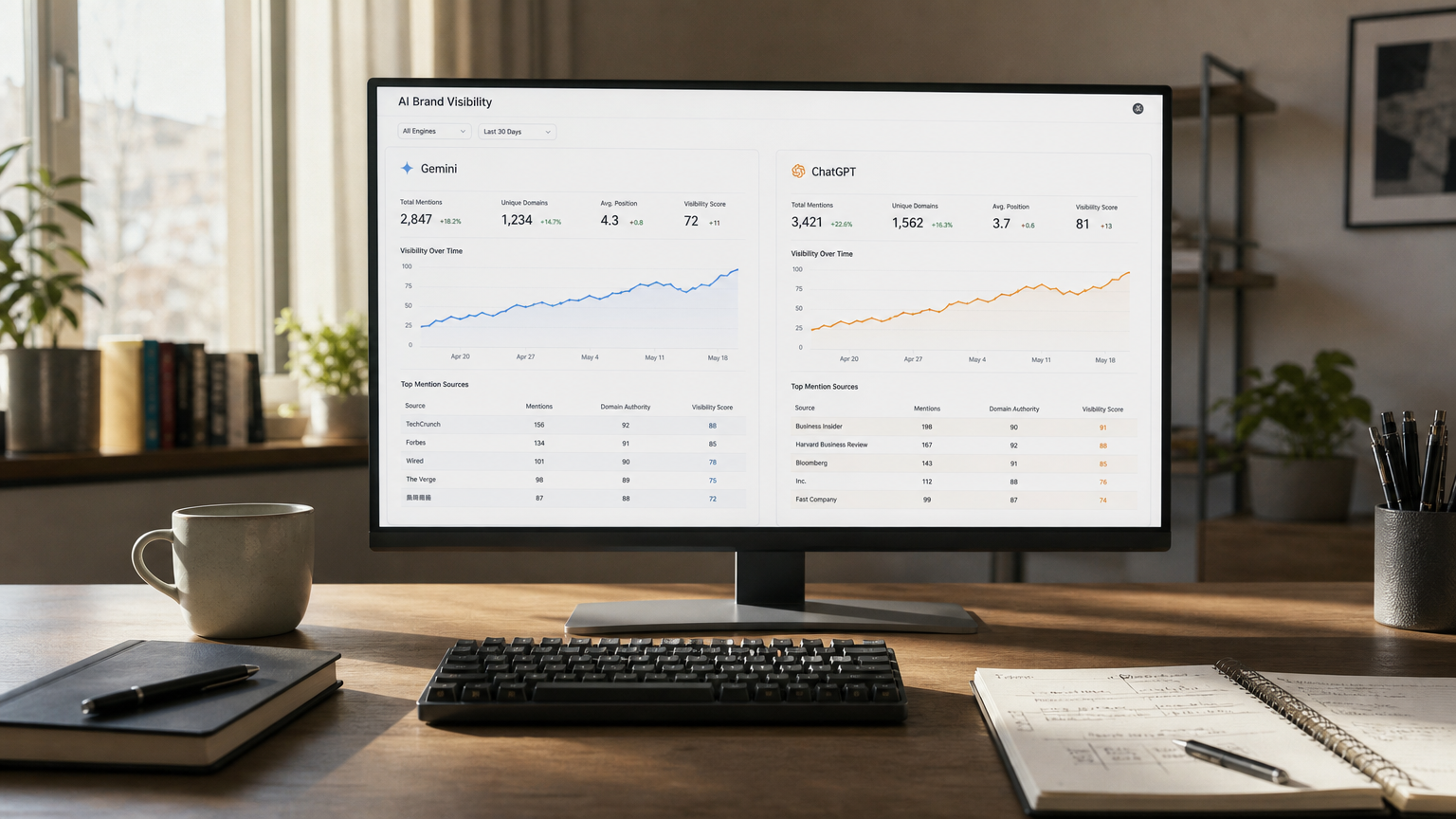
What the Piepertech report surfaces: fields and definitions
Before your team can act on AI search data, you need a shared vocabulary. Two terms matter most:
- Mention: the engine’s output contains your brand name as text, regardless of whether a source URL is attached.
- Citation: the engine provides a numbered source URL linked to the answer, and your brand’s domain (or a page referencing your brand) is one of those sources.
These are distinct measurements. Perplexity’s help center confirms that each answer includes numbered citations linking to original sources so users can verify information (Perplexity Help Center, “How does Perplexity work?”). Claude’s platform docs state that when the web search tool is active, the final response includes cited sources drawn from search results (Anthropic Claude Platform Docs, “Web search tool”). Both engines can, in theory, mention your brand without citing you, or cite a third-party URL that references you indirectly.
The Piepertech report captures both signals per run, in a single row per query per engine. Each row includes [confirm UI field names with product team]:
| Field | Description |
|---|---|
| Engine | Perplexity or Claude (expandable to other platforms) |
| Query tested | The exact prompt submitted to the engine |
| Mentioned (Y/N) | Brand name detected in the answer text |
| Cited (Y/N) | A source URL tied to the answer was returned |
| Citation URL(s) | The specific URLs returned as citations, if any |
| Answer snippet excerpt | The verbatim passage containing (or surrounding) the brand mention |
| Timestamp / Run ID | UTC timestamp and unique run identifier |
| Notes | Accuracy, sentiment, attribution context (e.g., “brand listed without product description”, “competitor mentioned in same sentence”) |
| Export status | Whether the row has been included in a CSV/Sheets export |
The report view defaults to engine-specific rows. A unified summary tab aggregates mention rate and citation rate across all engines for a selected date range and query cluster. [Confirm UI tab/toggle label with product team.]
Annotated report examples: Perplexity vs Claude
The tables below are representative mock examples illustrating how Piepertech structures output. They are annotated to show where each field maps to actual engine behavior.
Example 1: Perplexity run, brand mentioned and cited
| Engine | Query tested | Mentioned | Cited | Citation URL(s) | Snippet excerpt |
|---|---|---|---|---|---|
| Perplexity | “best AI search monitoring tools for marketing teams” | Y | Y | https://piepertech.nl/ai-monitoring | “Piepertech [1] offers cross-platform AI citation tracking…” |
Annotation: The [1] in the snippet corresponds to citation index 1. Perplexity’s API streaming response surfaces citation URLs as a structured list alongside the answer text (Perplexity Docs, “Streaming Citation Parsing”). Citation present = Y means that URL was returned in the citations array and the brand domain matches.
Example 2: Claude run, brand mentioned but not cited
| Engine | Query tested | Mentioned | Cited | Citation URL(s) | Snippet excerpt |
|---|---|---|---|---|---|
| Claude | “AI visibility monitoring for brand managers” | Y | N | , | “Tools such as Piepertech and others track generative engine visibility…” |
Annotation: Mention = Y because the brand name appears in Claude’s generated text. Citation = N because Claude’s web search tool was either not active for this session or did not return a source URL tied to the brand. Per Claude’s platform docs, citation sourcing depends on whether the web search tool is invoked and which results are retrieved. A mention without a citation is still valuable as a brand signal, but it’s harder to audit: there’s no URL to validate, no source to verify, and no evidence that the reference is grounded in current content.
This third pattern, “mentioned without citation,” is the most common failure mode in AI search visibility monitoring. It creates a false sense of coverage. Your brand name appears, but the engine hasn’t grounded that reference in any traceable source.
How to interpret mentions vs citations
A mention is a starting point, not a conclusion. Citation is the engine’s grounded evidence layer: it ties the mention to a retrievable source URL that you can audit for recency, accuracy, and relevance.
Common patterns to watch for:
- Passing reference in a list: the brand name appears alongside four or five competitors without any citation. Mention = Y, Cited = N. Low trust signal; audit whether your content is indexed and crawlable.
- Cited but in a low-relevance context: citation URL is a press release or a partner page, not your core product content. Cited = Y, but the snippet excerpt may describe an older feature or an unrelated use case. Check the Notes field.
- Mentioned with correct attribution: mention and citation both present, snippet excerpt is accurate. This is the result you’re optimizing toward.
Engine-to-engine discrepancies
If Perplexity mentions your brand but Claude doesn’t (or vice versa), several factors explain the gap. Perplexity operates as an AI-powered search and answer experience with real-time web retrieval and explicit citation output as a core design principle (“What is Perplexity?”, Perplexity Help Center). Claude’s citation behavior depends on whether the web search tool is enabled in a given session and which content blocks are returned as search results (Claude Platform Docs, “Search results”). Different retrieval paths, different crawl recency, and different prompt routing all produce different mention rates.
This is why a single manual check misleads. Checking Perplexity once on a Tuesday afternoon tells you what one session returned. It doesn’t tell you your mention rate across 20 prompts over 30 days.
Filtering and comparing engines in Piepertech
The filter panel [confirm filter UI names with product team] supports:
- Engine: Perplexity, Claude, or all engines combined
- Date range: rolling 7/30/90 days or custom
- Query cluster: awareness, consideration, or decision-stage prompts
- Mention status: mentioned Y/N
- Citation status: cited Y/N
For engine-to-engine comparison, run the same prompt set against Perplexity and Claude within the same time window, then compare mention rate (mentions / total runs) and citation rate (citations / total runs) side by side. Normalized rates are more reliable than raw counts because session volume may differ across engines.
Sampling discipline matters here. Run each prompt a minimum of five times over at least three separate days before drawing conclusions. AI engine outputs vary by session due to retrieval randomness, model temperature, and index freshness. A brand that appears in 1 out of 1 Perplexity runs may disappear in 4 out of 5 the following week. Trend tracking over time, not a one-off snapshot, is the operationally valid measurement unit.
Exporting and integrating data
[Confirm export formats with product/engineering before publishing.]
Piepertech supports export to CSV and Google Sheets [confirm availability]. Scheduled report delivery [confirm cadence options: weekly/monthly email] allows Brand and SEO teams to receive mention and citation summaries without logging in manually.
Dashboard integration with GA4 or CRM platforms [confirm integration support with engineering] enables cross-referencing AI citation activity against site traffic and lead pipeline data.
What to do with a weekly export:
- Filter for rows where Mentioned = Y and Cited = N. These are your highest-priority content gaps: the engine knows your brand but isn’t anchoring it to a retrievable source.
- Check Citation URL(s) for domains other than your own. Third-party citations about your brand may be outdated or inaccurate.
- Review snippet excerpts flagged in Notes with negative sentiment or incorrect attribution. These inform content correction priorities.
- Compare this week’s mention rate to the prior period. A drop following a site change or content update is a signal worth investigating.
- Package citation-present rows as an evidence bundle for leadership: engine name, query, citation URL, and snippet excerpt in a single sheet tab.
Security and data retention
Piepertech stores the following data per monitoring run: the query prompt submitted, the engine output text, any citation URLs returned, and the run timestamp. This data is used exclusively for the brand monitoring workflow and is not shared with third-party engine providers.
[Confirm data retention period with legal/engineering: e.g., 12 months rolling, or customer-configurable.]
[Confirm team account access controls: role-based access, SSO support, audit logs.]
[Confirm data residency: EU hosting, given piepertech.nl domain and GDPR applicability.]
Piepertech measures publicly accessible engine outputs only. Queries are submitted to Perplexity and Claude via their public interfaces or APIs. No proprietary user data is sent to those engines beyond the test prompts your team configures. Stored results are accessible only to authenticated members of your organization’s Piepertech account.
[Align the above privacy wording with Piepertech’s published privacy policy before going live.]
Leave a Reply